sábado, 23 de mayo de 2009

"Higher" Education: How to Raise Happy Children


Practical suggestions on education and for solving conflicts between parents and children.

"Education does not create anything new, but rather reveals what is already hidden within a person." (Rav Kuk, Essays of the Raiah, p. 100)


One can find valuable tips in guidebooks on raising children. A good tip can very often save months or even years of indecision and frustration, and help families out of dead end situations. However, we frequently encounter questions or situations that "catch us unprepared," and leave us wondering if we are capable of responding appropriately. In such situations, our response typically amounts to a perplexed smile or an obscure hum, covering up our lack of knowledge and great indecision as to what actually is the proper thing to do.

Being aware of children's developing curiosity and of many parents' distress, we decided to collect a few practical suggestions in each issue based on the authentic wisdom of Kabbalah, which relate to issues of the soul, to education and to the huge questions of little people. Enjoy!

An Answer to Every Question

Being parents will never be an easy job. In addition to long sleepless hours and concern for children's support and welfare, we find the most difficult and truly challenging task of all - supplying answers to each question they raise. Surely many of you are familiar with the scenario in which the sweet child opens a pair of huge, curious eyes, innocently looks you straight in the eye, and mercilessly shoots questions relating to the meaning of life and its purpose. In such cases, it doesn't really matter if you're a Dr. Spock fan, or a fervent reader of Tracy Hogg (author of the popular best seller, "Baby Whisperer"), you will most probably be left without answers, as the answers to these questions are not found in books.

That is precisely why we have chosen to dedicate the first tip of this section to the question of how to answer those huge questions asked by the little people growing up in our homes. Should we tell them what we think, even if the answer is not so "easy to digest", or should we evade a confusing answer, and leave them to cope with the question at a future stage in their lives?

Always tell the truth, but be consistently gentle.

"Be direct with the child, direct to the end, otherwise you will not gain his trust, since a child is sensitive to any falseness, as benign as it may be." (Yanush Korchak).

Above all, realize that children are sensitive by nature. If they detect that anything is being concealed from them, it can disrupt the entire system of mutual trust and respect with their parents. Therefore, if you hold important information or deep insight regarding life, don't hide it from your children. They are thirsty for that knowledge.

It is always preferable not to hide the truth from children, however, there is no need to burden them with issues they are still emotionally unprepared to handle. Practically speaking, if the truth is not simple, try to simplify and adapt it to the child's world of imagery, in a gentle and non-threatening way, so as not to pressure them. Remember that every story you tell your children comes to life and becomes real. It is your obligation as parents to be sensitive to the emotional and mental development of your children. Only in accordance with their emotional maturity, will you be able to reveal an additional level of the wisdom of life that you have accumulated over the years.

Therefore, sometimes it is better to wait for the demand for additional knowledge to come from the child himself, so he feels he is not being "pushed" into something he did not even request. His expression of willingness signals you that he is ready to absorb a deeper response. Lend an attentive ear and follow his reaction to the things you tell him, that is how you will be able to ensure that you are not burdening him too much and confusing him.

If you do not know the true answer to questions, don't be afraid to admit it, but don't evade your responsibility towards them to search for the answer, together with the children. As Albert Einstein once said, "What is important is to not stop asking questions."


The Secret to Child Education


Children will always want to be like adults. So if we want them to behave differently, we should first learn to do it ourselves


From the very first days of a child's life, we try to teach them the art of communication. We want children to "play beautifully," so we organize holidays and birthdays for them. We are concerned how to maximize their free time, and we spend considerable resources on educational games and training manuals for them. We are pleased when other adults can appreciate our children's intelligence and good manners. But we often forget that almost every day while children are at school they have to take the exam "for survival" among their peers.

Adults are always ready to meet children halfway, forgive and pity them, whereas in their relationships they have to fight with "fire and sword" for their rights: demand and give in, attack and defend, get used to their peers hostility towards them. And in spite of how much effort we spend to create an oasis for the child's happiness and prosperity, his real life happens outside our house.

There, in the big world, a child immediately has to learn to play according to different rules. He can see that the success and prosperity are earned with a lie, intrigues and brute force. But we ourselves have written these rules. Without taking notice of it, we accustom children to a policy of double standards. Every parent has roughly the same thoughts: "I am ready to do everything for my children to do well. And not just do well, but better than others."

With this "better than others" thinking we are slowly but consistently sawing the bough we sit on. At first children will subconsciously and then consciously adopt the rules of the game. The world is divided into "us" and "them" and if "they" stand in the way of our interests, they immediately become an ‘outlaw'. Outside of "our" law. Needless to say, we can see disastrous results of such an outlook in everyday life.

Is there an alternative? Kabbalah argues that yes, it exists, and by this way the interests of all will be taken into account. This means that regardless of affiliation to a certain group of people on social, national, religious and other grounds, every person is guaranteed respect for his vital interests. This will become not only the letter of the law, written in the constitution, but also inner aspiration of most people.

This is possible provided that everyone without exception follows the rule "anything that you hate, do not do to your friend". Simply by adhering to this rule, life would literally change, for the better, right before our eyes.

And children? Children will always want to be like adults. If we, the adults, begin to behave in another way, children will immediately imitate us. In kindergartens, schools and in the street, new games will appear in which children will learn from each other to live in a world of good. Therefore, the best that we can do for our children is to start with educating ourselves.

viernes, 22 de mayo de 2009

Humanity Is Tired of Wars


The world is suffering from a crisis. Sometimes people say, “I have suffered and I don’t want to unite with anyone.” In other words, people prefer to be secluded and to worry only about themselves. After all, no one takes care of them. Can it be that instead of uniting and realizing that the world is integral and global, people will, on the contrary, shrink into their shells? What will happen then?

My Answer: This is a real danger. The crisis can lead to nationalism in many countries, and then Nazi regimes and wars. Baal HaSulam, the great Kabbalist of the 20th century, wrote about this.

Nevertheless, after the Nazi regimes and the third and fourth world wars (which are possible but not necessary, according to Kabbalah), and after all the suffering that they will bring, humanity will still reveal the truth.

However, today Europe has reaches a state where it no longer wants to go to war, since it is exhausted from the previous wars. Europe has shed enough blood to learn this lesson.

However, the rest of the world has not yet gone through sufficient internal suffering to reach the same realization. The same realization can be attained through analysis, by looking at history and scientific data, or it can be reached through suffering and war.

This is why Baal HaSulam talks about the existence of two paths to the new world. And this is why we, his followers, are doing everything we can to eliminate the second path - the one that leads to nationalism, isolation of countries, and war.

The Crisis In Science Indicates a Need to Change Our Consciousness


In order to rise to the “human” level, to a level higher than the animate, one must acquire the quality of bestowal and love toward others. This is called “faith above reason” - bestowal above reception. and it enables a person to come out of himself and his egoistic nature.

Science is going through a crisis while it develops on the egoistic level. Meantime, humanity has gradually risen to a higher level, where everyone is interconnected as one body. From now on, the only way we can understand and reveal Nature is by becoming one whole. By making this change in our consciousness, we will reveal a deeper layer, new connections, forces and dependencies in the world around us.

But until we change our egoistic perception of reality to an altruistic one, our sensations, desires and thoughts will not allow us to overcome the knowledge barrier that we are stuck in. It is imperative that we rise above our egoistic reason to the altruistic reason. We must step outside ourselves, to a feeling that seems completely irrational to us today. This is why the subject of my PhD thesis was: “Kabbalah – The Irrational Method for Attaining the World.”

jueves, 21 de mayo de 2009

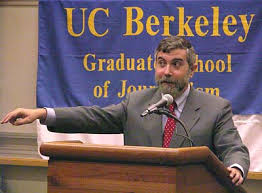
Paul Krugman: The Capitalist System Lies at the Foundation of Our Problems


At the end of his new book, economist Paul Krugman writes:

“One can safely claim that the role of today’s ‘capitalism,’ regardless of what one might call it, as the optimal method of combining individual freedoms, democracy, security, social and economic human rights, economic efficiency and social justice – must be reanalyzed as to the extent in which this system lies at the very foundation of our problems.”

Paul Robin Krugman – American economist and political writer. Holds a PhD from MIT, currently a professor at Princeton University. Awarded a John Bates Clark medal. He is a famous columnist for The New York Times and a laureate of the Adam Smith (1995), Recktenwald (2000) and Prince of Asturias (2004) awards. Honorary member of the Muenchen Economic Research Center (1997) and Group of Thirty. Awarded a Nobel Prize in Economics in 2008 for his analysis of the trade theory and problems of economic geography.

Anti-Semitism and the Economic Crisis


In order to assess explicit prejudice toward Jews, we directly asked respondents “How much to blame were the Jews for the financial crisis?” Among non-Jewish respondents, a strikingly high 24.6 percent of Americans blamed “the Jews” a moderate amount or more, and 38.4 per cent attributed at least some level of blame to the group.

My Comment: They are right, but on the other hand, see Items 70-71 of the “Introduction to the Book of Zohar.”